Great content rarely fails because the original idea was weak.
A business may have knowledgeable employees, strong customer stories, valuable industry experience, and a long list of topics worth discussing. Yet many of those ideas never become finished, approved, and published content.
Some remain in shared documents. Others sit in an unfinished draft. A few move between writers, managers, and clients for weeks before losing their relevance.
The real problem is often not creativity. It is execution.
As content volume increases, organizations must coordinate planning, writing, design, review, approval, scheduling, and publishing. When these activities are handled through disconnected systems, even the strongest ideas can become delayed, diluted, or forgotten.
Understanding why this happens is the first step toward building a content process that produces consistent results.
Key Takeaways
- Ideas fail when ownership, deadlines, and status are unclear.
- Disconnected tools fragment feedback, versions, and approvals.
- Calendars must connect planning to production and publishing.
- Social post scheduling belongs inside the workflow—not after it.
An Idea Is Only the Beginning
Coming up with an idea can feel like meaningful progress, but an idea alone does not create business value.
It still needs to move through several stages:
- The idea must support a business or audience objective.
- Someone must take responsibility for developing it.
- The content must be written or designed.
- The appropriate people must review it.
- Required changes must be completed.
- The final version must be approved.
- It must be added to the publishing calendar.
- Someone must publish or schedule it.
- Its performance should be reviewed.
A failure at any one of these stages can prevent the content from reaching its audience.
That is why effective content marketing strategies must address more than brainstorming. They need a reliable system for turning ideas into completed work.
1. No One Clearly Owns the Content
A common execution problem begins with unclear responsibility.
A manager may suggest a topic during a meeting, but no one is officially assigned to write it. A writer may prepare a draft, but they do not know who should review it. The design team may wait for approved copy while the manager assumes the visual is already being created.
When ownership is unclear, work slows down.
Every content item should have:
- A responsible creator
- A reviewer
- An approver
- A deadline
- A publishing date
- A clearly defined status
Without this structure, content teams spend too much time asking questions such as: Who is handling this? Has the client reviewed it? Which version is final? When is this supposed to be published? Is the image ready? Who has publishing access?
Good content execution replaces these questions with visible responsibilities and defined next steps.
2. The Workflow Is Spread Across Too Many Tools
Many organizations rely on several productivity tools to manage one piece of content.
The idea may begin in a messaging application. The brief is stored in a spreadsheet. The draft is written in a shared document. Images are placed in cloud storage. Feedback arrives by email. Approval is sent through a message. Publishing is handled through a separate social media scheduler.
Each tool may work well individually, but the full process becomes fragmented.
This creates several risks:
- Feedback is overlooked.
- Files are duplicated.
- Teams work from outdated versions.
- Approval decisions are difficult to confirm.
- Publishing dates are missed.
- Managers cannot see the complete status.
- Clients must repeatedly ask for updates.
The issue is not simply that the team uses several tools. The issue is that those tools do not operate as one connected workflow.
When people must manually transfer information between systems, execution becomes slower and less reliable.
3. Content Planning Is Not Connected to Production
A content calendar is useful, but it is not enough on its own.
Many businesses create a monthly calendar that lists topics and publishing dates. However, the calendar is disconnected from task assignments, drafts, approvals, and publishing activities.
A topic may appear on the calendar without answering important questions:
- Has the content been assigned?
- Has writing started?
- Is a visual required?
- Has the manager reviewed it?
- Is client approval still pending?
- Is the final content ready to publish?
A strong calendar should not only show what the organization hopes to publish. It should show whether the work required to publish it is actually progressing.
This is especially important when scheduling social media posts for several campaigns, clients, or platforms. The publishing date must be connected to the people, content, approvals, and assets behind it.
4. The Content Has No Clear Purpose
Some ideas fail because they were never connected to a defined content strategy.
A topic may sound interesting but still lack a clear reason for being created.
Before production begins, teams should understand:
- Who is the content for?
- What problem does it address?
- What should the audience learn?
- What action should the audience take?
- Which platform is most appropriate?
- How does the topic support the brand?
This is where content pillars become useful.
Content Pillars in Practice
For example, a content technology company might use pillars such as content strategy, artificial intelligence, social media operations, team collaboration, executive thought leadership, and digital branding.
Individual posts can then be developed under each pillar.
Using content pillars gives the organization direction. It prevents teams from publishing unrelated topics simply because they are popular or currently trending.
Trending topics may generate attention, but they should only be used when they naturally connect to the organization’s audience and expertise.
5. The Approval Process Becomes a Bottleneck
Approval is one of the most common reasons content is delayed.
A draft may require feedback from a manager, subject-matter expert, legal reviewer, executive, or client. When there is no structured approval process, feedback arrives through different channels and at different times.
One reviewer changes the opening paragraph. Another comments on an older version. The client requests an edit through a messaging application. The creator makes the change but forgets to inform the manager.
These small communication gaps create large delays.
A better approval workflow should make it clear:
- Who is currently reviewing the content
- What changes have been requested
- Whether those changes have been completed
- Which version is current
- Whether the content is approved
- What happens next
The goal is not to remove human review. Human review protects accuracy, quality, tone, and brand reputation. The goal is to make review structured and visible.
6. Content Is Created but Never Scheduled
Finishing the content does not guarantee that it will be published.
Many organizations have approved posts sitting in folders because no one moved them into the publishing schedule.
Social post scheduling should be treated as part of the content workflow, not as an unrelated administrative step.
A team should be able to move an approved post directly into a calendar, select a date and time, and prepare it for publication.
This becomes even more important when teams need to schedule posts on multiple platforms. Each platform may require different text lengths, image dimensions, hashtags, links, or publishing times.
Without a structured system, the team may need to manually rebuild the same post several times.
7. The Team Chooses Tools Based on Features Instead of Workflow
Businesses often search for the best tool to schedule social media posts and compare products based on the number of platforms, calendars, or automation options they provide.
Those features matter, but they do not solve the complete execution problem.
A basic social media scheduler may help a team schedule posts on social media, but it may not manage topic development, writing assignments, content creation, internal review, client feedback, approval stages, revision history, or content ownership.
Similarly, general project-management tools may track tasks but may not support post previews, social-platform requirements, content approvals, or direct publishing.
The best tool is not necessarily the one with the longest feature list. It is the one that supports the organization’s full working process.
When comparing tools for scheduling social media posts, organizations should ask:
- Can it connect planning to execution?
- Can managers assign responsibility?
- Can creators produce and organize content?
- Can clients or executives review content?
- Can feedback remain attached to the correct item?
- Can approved content move into the publishing schedule?
- Can the team track the complete lifecycle?
These questions reveal whether a tool improves execution or only completes one isolated task.
What Strong Content Execution Looks Like
A reliable content operation gives every idea a defined path.
Each stage should have a responsible person, a visible status, a clear deadline, relevant content and files, and a defined next action.
This creates accountability without restricting creativity. Writers can still explore ideas. Designers can still develop original visuals. Managers can still protect quality. Clients can still provide feedback.
The difference is that every person works through a shared process rather than disconnected communication.
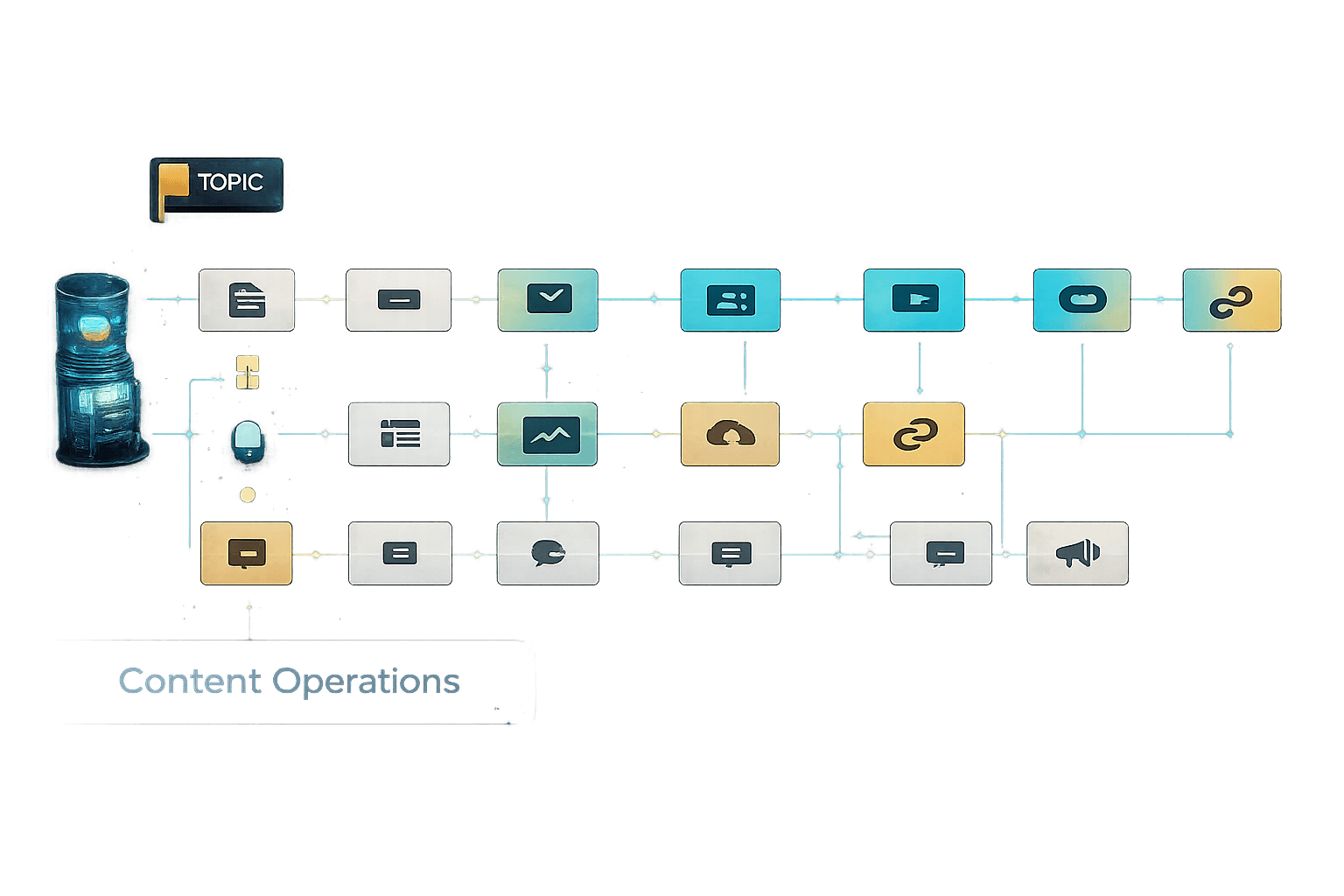
What Strong Content Execution Looks Like
A practical content operations workflow
How Flowence Supports Better Content Execution
Flowence, a product of Alayrix, is designed to bring the content lifecycle into one structured environment.
Instead of treating content creation, approvals, scheduling, and publishing as separate activities, Flowence connects them into a shared workflow.
Teams can use the platform to support:
- Content planning
- Calendar visibility
- Task assignment
- AI-assisted and manual content creation
- Internal review
- Client review and approval
- Content status tracking
- Scheduling
- Multi-platform publishing where supported
- Centralized content management
For agencies and organizations, the value goes beyond being another social media scheduler.
Flowence is designed to help creators, managers, clients, and executives work through the same connected process. This reduces the need to search through email threads, spreadsheets, shared folders, and messaging applications just to determine what is happening with one content item.
It also gives clients greater visibility without requiring them to participate in every internal discussion.
From Idea to Published Content
Plan & Assign
Connect topics, owners, and deadlines so every idea has a clear next step.
Create & Review
Produce drafts with AI-assisted or manual creation, then review in one place.
Approve & Schedule
Move approved content into social post scheduling across platforms.
Publish & Measure
Publish with visibility and track operational performance by pillar and team.
How Better Scheduling Protects Great Ideas
Scheduling is not only about selecting a date. It gives the content a real commitment.
When a post is assigned a publishing date, the team can work backward to establish:
- Draft deadlines
- Design deadlines
- Review periods
- Client approval dates
- Final preparation requirements
A structured approach to scheduling social media posts also helps organizations maintain a consistent presence instead of publishing only when someone remembers.
Consistency builds familiarity. Familiarity strengthens trust. Over time, that trust can support stronger engagement, better brand recognition, and more meaningful business relationships.
Content Execution Should Be Measured
Publishing is not the final step. Teams should review how effectively content moves through the workflow.
Useful operational measurements may include:
- Time from idea to first draft
- Time spent waiting for approval
- Number of revision cycles
- Percentage of posts published on time
- Number of missed publishing dates
- Content output by campaign or team
- Approval turnaround time
- Performance by content pillar
These measurements help identify whether the problem is creativity, production capacity, approval delays, or poor planning.
Without this information, teams may continue creating more ideas while ignoring the bottleneck that prevents those ideas from being executed.
Final Thoughts
Great content ideas are valuable, but ideas do not create impact until they are developed, approved, and published.
When content execution depends on scattered files, unclear responsibilities, manual reminders, and disconnected tools, strong ideas are easily lost.
The solution is not simply to create more content. It is to build a better system for moving content forward.
A connected workflow gives teams clarity, gives managers control, gives clients visibility, and gives every worthwhile idea a better chance of reaching its audience.
Flowence helps organizations move from scattered content activity to a structured process—from the first idea to approved, scheduled, and published content.