
Ask an AI tool to write a social media post, and it can produce a draft within seconds.
Give an AI image creator a description, and it can generate a visual almost as quickly.
That speed is valuable. But creating a post is only one step in a much larger process.
Someone still needs to decide why the content is being created, whether it reflects the brand correctly, who should review it, when it should be published, and how it fits into the wider content strategy.
So, while AI can create content, can it manage the entire content process?
Not by itself.
Key Takeaways
- AI content creation speeds drafts—but does not replace ownership, approval, or scheduling.
- Strategy, brand judgment, and accountability remain human responsibilities.
- Standalone AI tools fall short when review and publishing stay disconnected.
- The opportunity is AI inside a connected Flowence workflow—not AI alone.
AI Has Made Content Creation Faster
AI content creation can help businesses move past the blank page.
It can support teams by:
- Suggesting topics
- Drafting captions and articles
- Rewriting content in different tones
- Creating platform-specific variations
- Summarizing longer material
- Producing visual concepts
- Generating AI images
- Repurposing one idea into several formats
These capabilities can reduce repetitive work and allow creators to spend more time on strategy, quality, and originality.
However, speed at the creation stage does not automatically create an effective content operation.
A business can generate 50 posts in one afternoon and still fail to publish consistently.
Content Is More Than a Draft
A finished draft is not the same as completed content.
Before a post reaches the audience, it may need to move through several stages.
Each stage requires a different type of decision.
AI may help with writing and visual creation, but it does not automatically know:
- Which campaign has priority
- Who is responsible for the post
- Whether the information is accurate
- Which executive must approve it
- Whether the client requested changes
- Which version is final
- When the post should go live
- Whether it fits the publishing calendar
- How its performance should influence future content
This is the difference between content generation and content management.
Content Is More Than a Draft
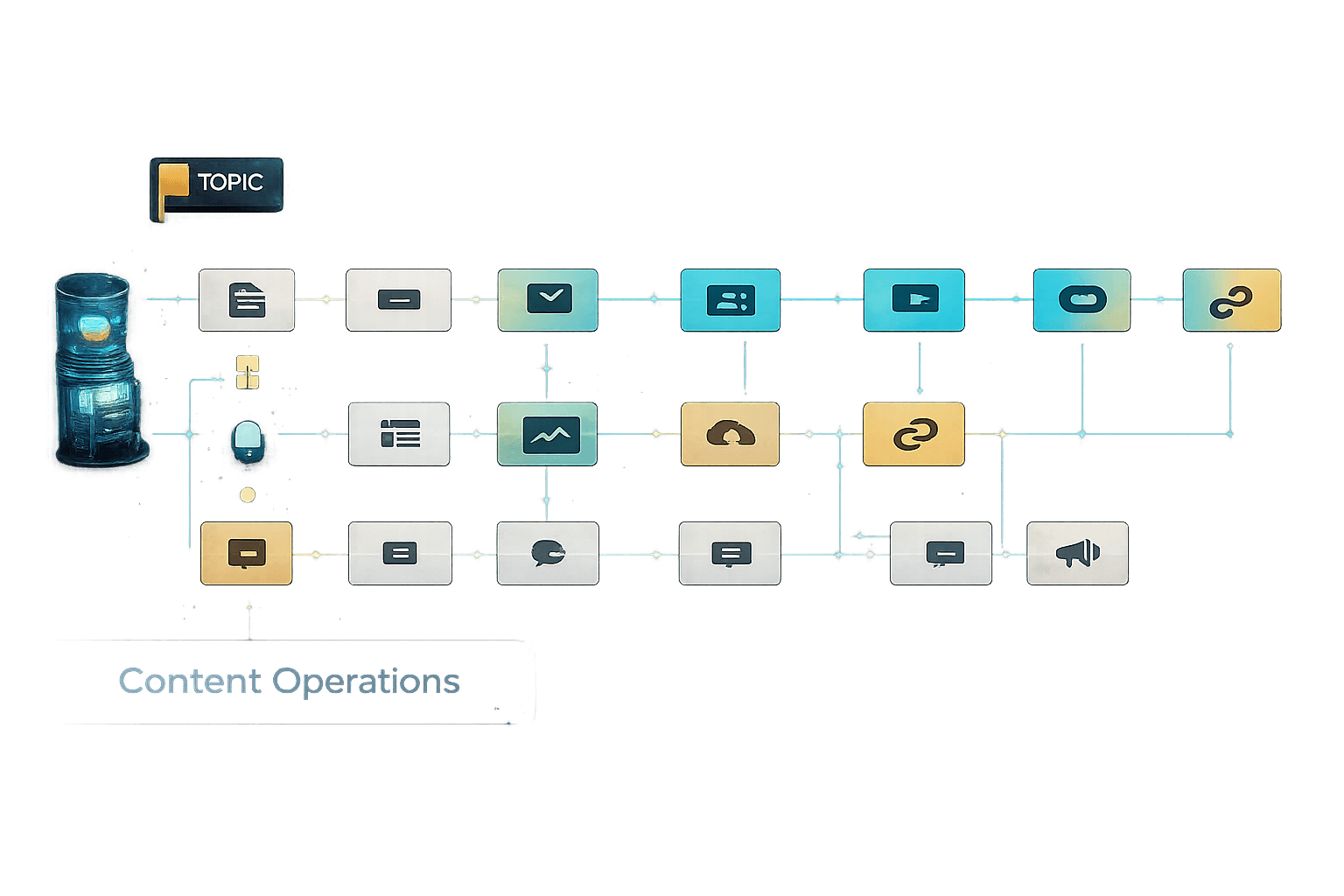
Plan → Assign → Create → Review → Revise → Approve → Schedule → Publish → Measure
Where Standalone AI Tools Fall Short
Standalone AI tools often excel at generating drafts and visuals, yet leave strategy, ownership, approvals, and publishing outside the workflow.
1. Strategy and Business Context
AI can suggest trending topics, but popularity does not always make a topic valuable for a particular business.
Strong content marketing strategies begin with questions such as:
- Who is the audience?
- What does the business want to achieve?
- What problem should the content address?
- How does it support the brand’s expertise?
- What should the audience do next?
AI can assist with these questions, but people must provide the business context and make the final strategic decisions.
Without that direction, AI may generate polished content that says very little.
2. Brand Voice and Judgment
AI can imitate a tone, but brand voice is more than choosing between “professional” and “friendly.”
It reflects:
- The organization’s values
- Its relationship with its audience
- Industry expectations
- Cultural context
- Executive preferences
- Legal and reputational considerations
Human review remains essential, especially for sensitive, technical, medical, legal, financial, or executive content.
The most effective use of AI is not to remove people from the process. It is to help them work more efficiently while preserving judgment and accountability.
3. Ownership and Accountability
AI can produce a draft, but it cannot take organizational responsibility for moving that draft forward.
Someone still needs to know:
- Who is writing or editing
- Who is preparing the visual
- Who is reviewing
- Who is approving
- Who is responsible for publishing
When these responsibilities are unclear, content becomes delayed—even when the draft itself was created instantly.
This is why businesses often need more than disconnected productivity tools. They need a visible workflow that connects people, deadlines, content, and decisions.
4. Review and Approval
Content may require several levels of review.
A marketing manager may check the message. A subject-matter expert may verify accuracy. An executive or client may need to approve the final version.
When feedback is scattered across emails and messages, problems quickly appear:
- Different reviewers comment on different versions.
- Requested changes are overlooked.
- Nobody knows whether the content is approved.
- Publishing is delayed while the team waits for confirmation.
AI can help revise content, but it cannot replace a structured approval process.
The draft still needs a clear status, recorded feedback, and an authorized final decision.
5. Scheduling and Publishing
A standalone AI tool may create content, but it usually does not manage the complete publishing operation.
Businesses still need to:
- Organize posts in a calendar
- Select publishing dates
- Coordinate campaigns
- Adapt posts for different channels
- Complete social post scheduling
- Track what has been approved
- Schedule posts on multiple platforms
A social media scheduler may handle the final publishing step, but that creates another problem when creation, review, approval, and scheduling take place in separate systems.
Effective scheduling of social media posts should be connected to the work that comes before it.
An approved post should not need to be copied manually from one tool into another before it can be scheduled.
The Real Opportunity: AI Inside the Workflow
The better question is not whether AI can replace the entire content process.
It is how AI can strengthen each stage of that process.
A connected content workflow may use AI to:
- Suggest ideas based on defined themes
- Create initial drafts
- Produce visual concepts
- Refine clarity and tone
- Adapt content for different platforms
- Summarize reviewer feedback
- Prepare alternative versions
People then provide strategy, expertise, approval, and final control.
This combination creates a stronger model: AI for speed. People for judgment. Workflow for consistency.
AI Inside the Workflow
Ideate & Draft
Use AI content creation for topics, captions, variations, and AI images.
Review & Approve
Keep human judgment on accuracy, brand voice, and final authorization.
Schedule & Publish
Move approved work into calendars and multi-platform social post scheduling.
Measure & Learn
Track status and results so AI-assisted output improves over time.
How Flowence Connects the Process
Flowence, a product of Alayrix, is designed as an AI-powered content operations platform rather than only an AI writer or isolated scheduler.
It connects AI-assisted creation with content planning, collaboration, review, approvals, scheduling, client visibility, and publishing within one structured environment.
- An idea is added to the plan.
- A task is assigned.
- Content is created manually or with AI assistance.
- The draft is reviewed.
- Feedback and revisions remain connected to the content.
- The appropriate manager, executive, or client approves it.
- The approved content moves into the publishing calendar.
- It is scheduled or published to connected channels where supported.
- Its status and results can be tracked.
The value is not simply producing content faster.
It is preventing faster content creation from creating more drafts, more files, and more confusion.
AI Should Reduce Work, Not Remove Control
Businesses should be cautious of the idea that the entire content process can be completely automated.
Content represents the organization publicly. It can influence trust, reputation, customer relationships, and commercial decisions.
Removing every review step may save time, but it can also increase the risk of:
- Incorrect information
- Generic messaging
- Brand inconsistencies
- Inappropriate claims
- Repetitive content
- Poor cultural judgment
- Publishing mistakes
AI works best when it reduces unnecessary effort while keeping the right people involved in important decisions.
Final Thoughts
AI can create a caption, article, or visual in seconds.
But content success depends on much more than creation.
It requires strategy, ownership, brand context, collaboration, review, approval, scheduling, publishing, and performance visibility.
A collection of AI tools may help with individual tasks. A connected content operations platform helps manage how those tasks work together.
The future of content is therefore not AI working alone.
It is AI working inside a clear, human-controlled process that turns ideas into approved, scheduled, and published content—consistently and at scale.